
Image
BMC2 Coordinating Center
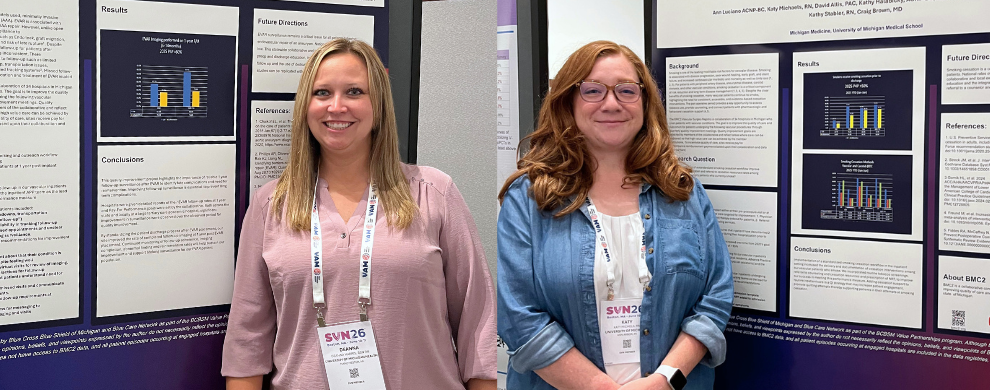
BMC2 quality projects were presented during two poster presentations at the Society for Vascular Nursing 2026 Annual Conference, June 10 - 13 in Boston.
In "Staying Connected: Enhancing Post-Operative Follow-Up for Aneurysm Patients," Deanna Harris, RN, and co-authors asked if implementation of a standardized tracking and outreach workflow can improve adherence to recommended long-term surveillance imaging among EVAR patients at 1 year post-implant.
To improve post-EVAR imaging at 1-year follow-up for their vascular inpatients undergoing EVAR placement, they utilized the inpatient APP team as the lead for promoting and implementing the performance measure recommendations.
Barriers identified from interviews with patients included:
- Patient barriers (Communication breakdowns, transportation issues, asymptomatic so “don’t need follow-up”)
- Inconsistent education resources
- Variability in tracking follow-up timeliness
- Loss to follow-up after missed appointments
- Unclear assignment of responsibility for ongoing surveillance
Based upon these barriers, the following recommendations for improvement were instituted:
1. Standard communication with the patient about that their condition is chronic and the need for follow-up despite feeling well
2. Increased use of local imaging with virtual visits for review of imaging, or partnership with regional vascular practices for follow-up
3. Standard education materials so that patients understand the need for follow-up imaging
4. Assign dedicated staff to track, flag missed visits, and communicate with patients to reschedule appointments.
5. Providers (MD and APPs) reinforce follow-up requirements at every visit
6. Implementation of redundant systems for messaging to reinforce the importance of surveillance imaging and visits
As a result, the Michigan Medicine EVAR imaging performed on 1-year follow-up in 2024 was >80%.
This quality improvement project highlights the importance of reliable 1-year follow-up surveillance after EVAR to identify late complications and the need for reintervention. Improving follow-up surveillance is essential to preventing long-term complications.
By standardizing the patient discharge process after EVAR placement, Michigan Medicine improved the rate of completed follow-up imaging at 1 year post-EVAR placement. Continued monitoring of follow-up adherence, imaging completion, abnormal findings, and reintervention rates will help sustain their improvement and support lifelong surveillance for our EVAR patient population.
Poster authors are Ann Luciano, ACNP-BC; Deanna Harris, RN; David Allis, PAC; Kathy Halabicky, ACNP-BC; Rachael Scheich, ACNP-BC; Kathy Stabler, RN; and Craig Brown, MD.
In "From Advice to Action: Strengthening Smoking Cessation Counseling Through QI Initiatives," Katy Michels, RN, and co-authors asked if implementation of a standardized smoking cessation workflow can improve counseling documentation and referral to smoking cessation resources rates among inpatient vascular surgery patients who currently smoke.
Patients were identified as current smokers either at their pre-procedure visit or at hospital admission. Three interventions were targeted for improvement: 1. Physician-delivered advice, 2. Nicotine replacement therapy ordered for patients, 3. Referral to inpatient or outpatient smoking counseling services.
The BMC2 Pay-For-Performance metric requires that a patient have documented two of the three interventions either preoperatively or during their hospitalization prior to discharge.
Over the years of measurement, the P4P goal increased over time from 2023’s goal of > 25%, to 2025’s goal of > 50% to 2026’s goal of > 65%
To improve smoking cessation counseling in Michigan Medicine vascular inpatients undergoing revascularization, they utilized the inpatient APP and nursing teams as the lead for promoting and implementing the performance measure recommendations.
Areas identified for improvement included:
1. Addition of a smoking cessation measure in the admission template
2. Pre-filled orders to the smoking cessation team and nicotine replacement therapy added to the admission template
3. Nicotine replacement therapy ordered for inpatients to manage withdrawal symptoms
For 2025 P4P, Michigan Medicine's rates for smokers receiving smoking cessation prior to discharge were 73.7%.
Michigan Medicine's smoking cessation methods for vascular and carotid at discharge for 2025 year to date (January through June) were 71.1% for physician-delivered advice, 21.1% for nicotine replacement therapy, and 60.5% for smoking cessation counseling service.
Implementation of a standardized smoking cessation workflow in the inpatient setting increased the delivery and documentation of cessation interventions among their vascular patients who smoke. They incorporated routine tobacco screenings, referrals to counseling and cessation resources, and prescription of nicotine replacement therapy to improve their success in meeting this performance measure. Adding cessation support to routine inpatient care is a quality initiative strategy that may increase patient engagement and promote quitting attempts, thereby supporting patients in their attempts at smoking cessation.
Poster authors are Ann Luciano, ACNP-BC; Katy Michels, RN; David Allis, PAC; Kathy Halabicky, ACNP-BC; Rachael Scheich, ACNP-BC; Kathy Stabler, RN; and Craig Brown, MD.